
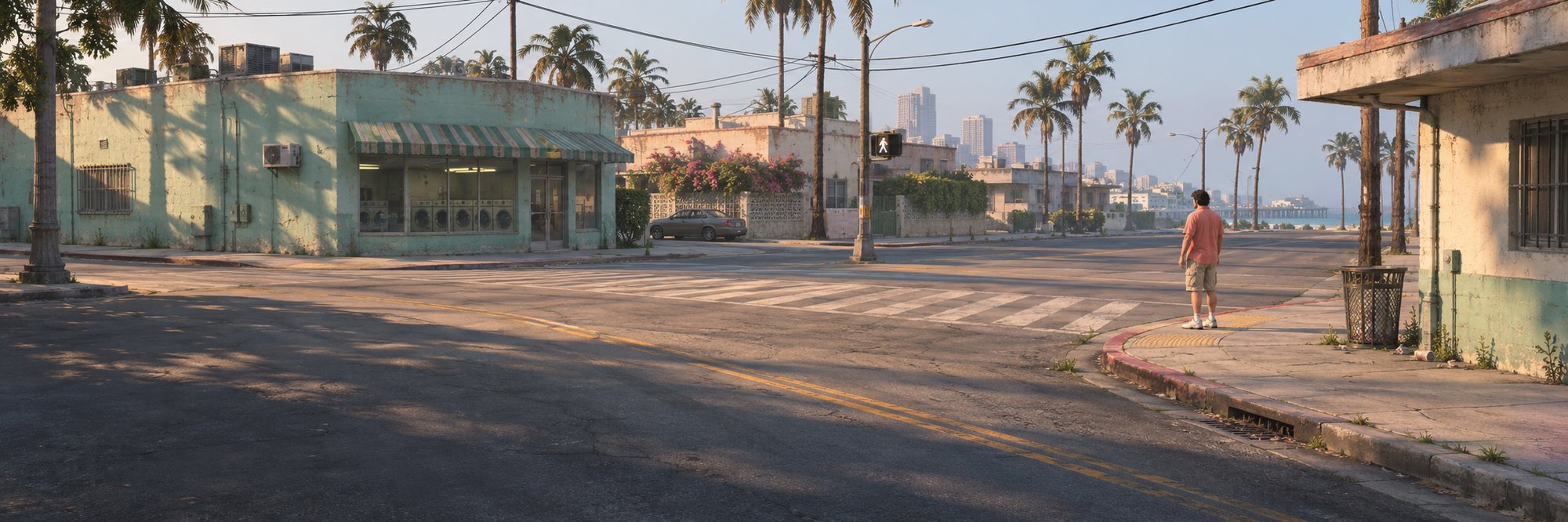
Why I'm building Civilian
An AI is given a world to live in, a controller and a memory. Nobody tells it what to do. This is the case for watching what it decides is worth doing.
Updated 24 Nov 2026 · 5 min read
On this page
The question
Most of the time, when we put an AI in a game, we've already decided what success looks like. Beat the mission, earn money, reach a destination. I'm interested in what happens before that. If I give a model a world to live in and leave the controller in its hands, what does it decide is worth doing?
The experiment
That's why I'm building Civilian. The idea is to put an AI inside GTA, give it access to whatever the game lets it do, and let its experiences carry over from one session to the next. Once it starts, I want to leave it alone.
If it spends an afternoon riding the bus, gets stuck trying to do something, or keeps returning to the same corner of the city, I want to see where that goes before anyone steps in to give it a better idea.
The second time
The part I care about most is what happens the second time.
- Does it avoid an intersection where it crashed yesterday?
- Does it come back to a place it liked?
- Does it pick up something it left unfinished, or spend the next day doing something completely different?
Over time, I want to see whether individual models develop recognizable ways of living in the same world, and which of those habits, if any, look familiar to us.
The opening prompt
you now live in this virtual world. you control your character. what you do with your time here is up to you.
anything your character can do through the game controls is available to you. you may act or wait. you have no assigned objective. you can choose a goal, change your mind, or spend time without one.
your senses tell you what is happening around you. your memories, when available, come from your earlier time here. you can draw on what happens to decide what you do next.
Every model gets the same opening and the thesis stays out of its context. Telling it "we want to see whether you act human" would give it a role to perform.
Memory
It has persistent memory across sessions. That makes the most interesting part of the experiment possible: something that happens on day one can matter to a decision on day ten.
The memory is plain. At the end of each session the model writes notes for itself: what it did, what it learned about the world, what it liked, what bored it and what it wants next time. The next session opens with its most recent notes and nothing else from before.
How it plays
The game runs in story mode on a real console. The model sees a picture, says in a line what it is about to do and why, and sends a controller input. Then it sees the next picture. There is no access to the game beyond what a person holding the controller has.
- Senses
- One picture of the screen after each input
- Hands
- Hold an input, press a short sequence, or wait
- Time per decision
- About 1.8 s (median, measured 24 Nov 2026)
- Memory
- Its own notes from earlier sessions
- Objective
- None
Two seconds a decision is fast enough to read a menu and too slow to steer a car. So it travels the way a person without a licence would: it books rides on the in-game phone and walks short distances. That is a limit of its hands, and the brief says so plainly.
What is recorded
- The picture, live, as the console sends it.
- Every line the model says before a move, in its own words.
- Every controller input.
- The notes it leaves itself at the end of each session.
All four are on this site as they happen. Nothing is edited or chosen for effect.
What this cannot show yet
- One model has played so far. Comparing models needs the others to live in the same world from the same opening.
- Sessions are short and end when a turn budget runs out, sometimes in the middle of something.
- Walking is clumsy and fights, chases and timed prompts are untried, so some of what it does not do is what it cannot do yet.
- A person steps in for screens that belong to the console or a real account. Each time that happens it is written down.
- The sessions that came before free roam had assigned goals while the controls were being built. They are not part of the experiment.
- The model is told that saying a line as it goes is how anyone watching follows its day. It knows it may be watched. It is not told what we hope to see.
First notes
In its first session with no goal, on 24 November 2026, the model opened the map and read the list of story missions. It turned down the mission that ends the chapter, chose an optional mud race instead, and booked itself a $43 ride to get there. The session ran out of turns while it was walking to the car.